In this Hampstead home (NW3) there were signs of a leak under the kitchen units. Our engineer took off the kitchen plinth and traced it to the sink waste pipe, which had come apart in two places. It only leaked when waste water backed up the pipe. On a second visit we disconnected the pipe, had it rodded through to the outside manhole, re-joined it and tested it. No further issues were found.
What we found on the first visit
The tenant had reported that the kitchen sink was often getting blocked. Our engineer removed the kitchen plinth (the kick board along the bottom of the units) to look underneath. There were signs of a leak under the units.
The leak was coming from the sink waste pipe. It was:
- dislodged in two places
- showing visible marks where it had been leaking
- loose at the joints, where it should have been solvent jointed (glued)
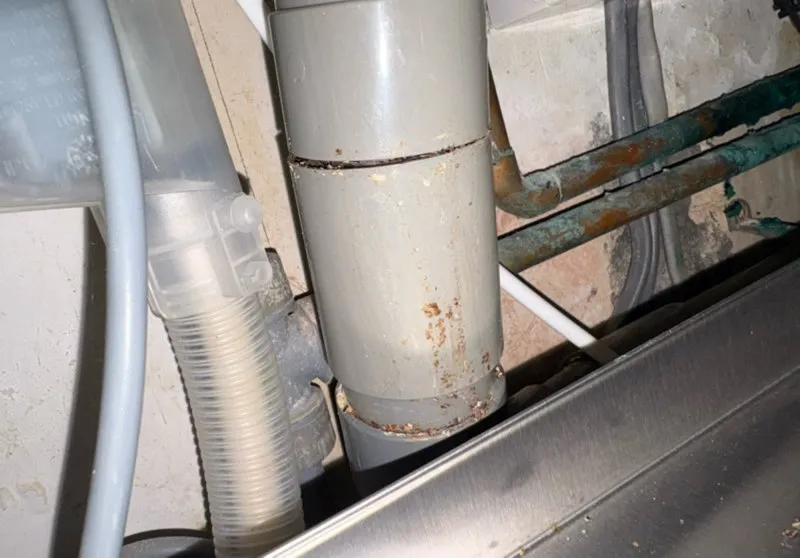
The pipe was only leaking when the waste water was backflowing. In other words, when water could not drain away fast enough, it backed up the pipe and came out of the loose joints.
To test this, our engineer ran the tap and drained the dishwasher for 20 minutes. No blockage happened during the test. We also checked the outside manhole and found it clear.
We sent a quote for the repair.
What we did on the second visit
On the second visit, our engineer:
- disconnected the kitchen waste pipe
- had a drainage engineer rod through the pipe all the way to the manhole
- re-joined the pipe and tested it
- straightened the water softener overflow pipe under the units
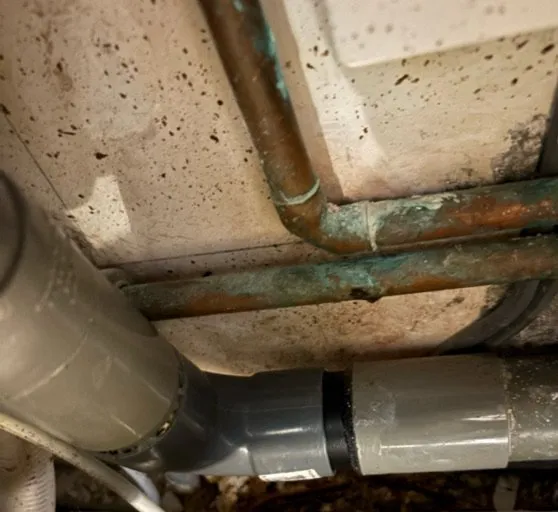
The pipe was tested after the work and no further issues were found.
Why a leak can come and go
A leak that only shows up now and then is one of the hardest to find. With a waste pipe, the water is not under pressure like a supply pipe. It normally runs away downhill. A loose joint can stay dry for days while the water flows freely.
The trouble starts when the pipe partly blocks. Water backs up, the level in the pipe rises, and it finds its way out of any joint that is not sealed. That is why a slow-draining sink and a leak under the units often go together.
Signs to look out for:
- the sink drains slowly or gurgles
- a damp or musty smell under the sink
- swollen or stained plinths and cupboard bases
- water marks on the floor when the dishwasher or washing machine empties
Push-fit and solvent joints
Plastic waste pipes are joined in two main ways. Push-fit joints use a rubber seal and can be pulled apart. Solvent joints are glued with a special cement and become one piece. Where a pipe is meant to be solvent jointed, a joint that has just been pushed together can slowly work loose, especially under a sink where pipes get knocked.
If you see a waste joint that moves when you touch it, or a pipe that has slipped out of its fitting, get it looked at before the leak spreads into the floor or the units.
Landlords and tenants
If you rent, tell your landlord or agent about a slow sink or a leak as soon as you notice it. Drains and waste pipes are normally the landlord’s job to repair. It helps to say when it happens, for example “only when the dishwasher empties”. That kind of detail helps us find the fault faster.
For more on tracking down the cause of a leak, read our guide to damp and leak investigation. If water damage has already reached the floor, see water-damaged wood floor repair.
Leak and waste pipe repairs in Hampstead
We find and fix leaks across Hampstead, Camden, Belsize Park and the rest of north London. See our leak detection service, our plumbing and heating services, our drainage and CCTV service and our Hampstead area page.
Leak under the sink or a slow drain? Call 020 8227 0035 or ask for a quote.