This job was a call-out to a home in Ilford, Essex (IG6), in the Hainault and Barkingside side of the town. The owner had noticed water showing under the floor near the bathroom and asked us to find out where it was coming from. Leaks like this are worrying because you can see the water but not the source. Here is how our engineer tracked it down, what he fixed, and the signs to look out for in your own home.
The problem: water under the floor, but no obvious leak
When water appears under a bathroom floor, the usual suspects are the shower, the bath, the toilet or the sink. But a bathroom also has pipes you never see: the hot water and heating pipes that run inside the walls and under the floor to the towel radiator. A slow leak on one of those can soak the floor for weeks before anyone notices.
There is one clue that often points to the heating side rather than the taps: the boiler losing pressure. A combi or system boiler runs on a sealed heating circuit. If water is escaping from a radiator pipe, the pressure on the boiler gauge slowly drops and the boiler has to be topped up again and again.
What we found
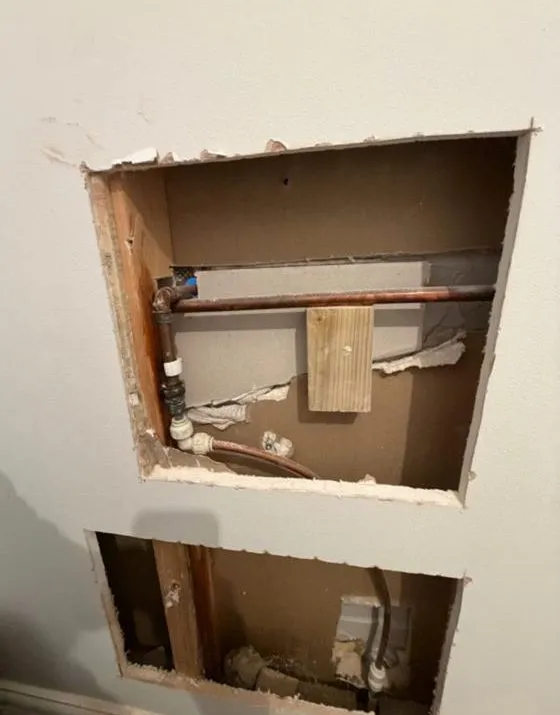
After checking the bathroom, our engineer worked out that the leak was most likely coming from the concealed pipework feeding the bathroom towel radiator. The pipes ran inside the wall on the bedroom side, so there was no way to see them without opening the wall.
With the resident’s permission, he cut neat access holes in the bedroom wall to expose the pipework. That confirmed it: the leak was coming from those pipes.
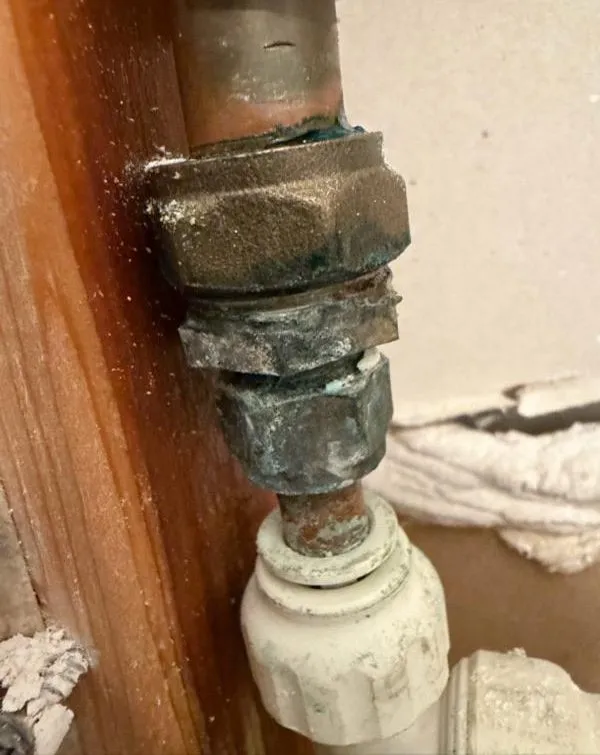
The photo shows why. The old brass joint is covered in green and white crusting. That build-up is a tell-tale sign of a joint that has been weeping slowly for a long time: each drop of heating water dries and leaves minerals and corrosion behind.
What we did
On the day, our engineer:
- Opened up the wall from the bedroom side, keeping the openings as small as possible, to get to the concealed pipes.
- Confirmed the source of the leak on the towel radiator pipework.
- Supplied and fitted new pipe connections in place of the old leaking ones.
- Re-pressurised the boiler and watched it. The leak stopped and the pressure held with no further drop.
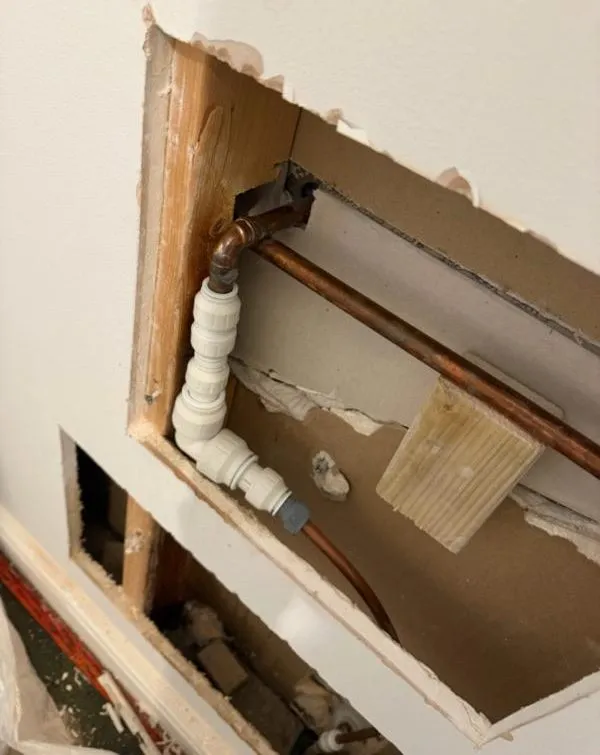
Getting the leak stopped and the heating back to normal came first. A return visit has been booked to re-board the opened wall, fill, sand and redecorate, so the room is put back as it was.
Why it matters
A small, steady leak from a heating pipe does more harm than it looks:
- Floors and walls stay wet. Chipboard floors swell, timber can rot and plasterboard breaks down.
- Mould can start in the hidden space behind the wall or under the floor.
- The boiler keeps losing pressure. Topping it up again and again brings fresh, oxygen-rich water into the system, which can speed up corrosion inside radiators and the boiler itself.
- The boiler may lock out when pressure gets too low, often on the coldest night of the year.
Finding the real source, rather than guessing, also saves money. Opening a wall in the right place is a small repair. Lifting a whole bathroom floor because you guessed wrong is not.
How to spot the same problem at home
Look out for:
- Boiler pressure that keeps dropping. Most boilers like to sit at around 1 to 1.5 bar when cold. If you are topping it up every week or two, there is a leak somewhere.
- Damp or stained flooring near a radiator, especially a towel radiator in a bathroom.
- Green or white crusting on radiator valves and pipe joints you can see. It usually means a slow weep.
- Bubbling paint, damp skirting or a musty smell on the other side of a bathroom wall.
- Damp patches on the ceiling below, if the bathroom is upstairs.
If your boiler pressure keeps falling, don’t keep topping it up and hoping. Turn the heating off if you see water, and book a plumber to trace the leak. Our guides to damp and leak investigation and radiator replacement for corrosion and leaks explain more, and you can read about another hidden leak in our shower cartridge case study.
Is it time for a new boiler?
In this home the boiler was fine once the leak was fixed. But if your boiler is old and keeps losing pressure or breaking down even after leaks are repaired, it may be time to think about replacing it. Our guide to the signs a boiler needs replacing explains what to look for.
Need a leak traced in Ilford, Hainault or Barkingside?
We find and fix leaks for homeowners, landlords and letting agents across east London and Essex. See our leak detection service, plumbing and heating service, radiators and heating service, boiler servicing and repairs and boiler replacement.
We work all around this part of Essex and east London, including Ilford, Hainault & Barkingside, Chigwell, Woodford, Romford and Barking.
Call 020 8227 0035 or get a quote online.