This visit was to a flat in an HMO (house in multiple occupation) in Southwark (SE1). Our engineer fitted a new thermostatic shower bar, adjusted the water pressure and secured loose pipework. He found the tundish was disconnected, which could have caused a flood, and fixed it. He also lifted part of the decking to look for a leak. That area was dry, but he found gaps in the coping cladding with rotted wood beneath. He sealed the gaps and secured the cladding.
What we found
There were four jobs on the list.
- The shower. The thermostatic shower bar needed replacing.
- Loose pipework. Some pipes were not fixed in place.
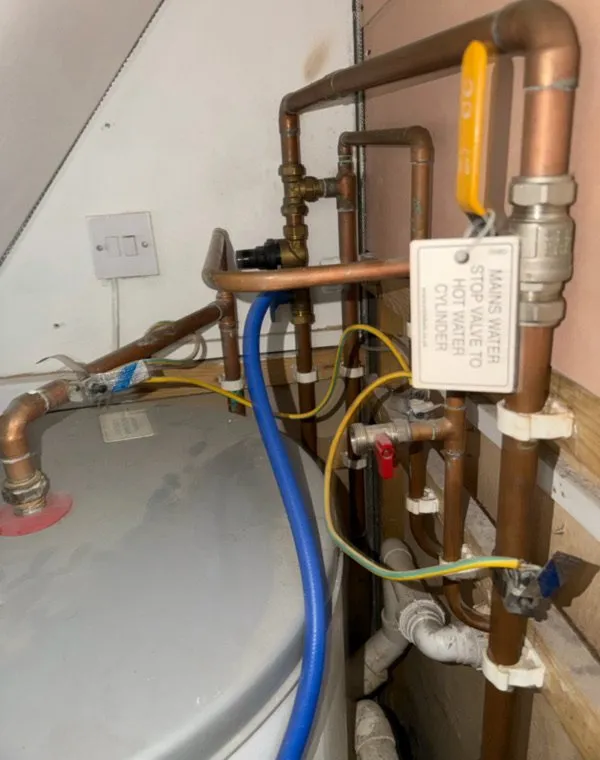
- The tundish. The tundish was found disconnected. If any pressure relief valve had discharged, the area could have flooded. The pipe was also too short, and its drop was making it touch other pipes.
- A leak to the flat below. We were told that in May this year, heavy storms blew away some of the cladding. It was put back within one to two months, and in that time there were leaks to the flat below.
Our engineer removed a section of the decking and inspected underneath. Nothing there showed signs of water leaking through. But the coping cladding plates (the capping along the top edge) had a large gap between them, with rotted wood underneath.
What we did
- Supplied and fitted a new thermostatic shower bar and tested it.
- Adjusted the water pressure. The shower was working as required.
- Secured all the loose pipework.
- Supplied and fitted an extension connector on the tundish pipe, so it was connected again and no longer touching other pipes.
- Sealed all the gaps in the coping cladding and secured it in place.
We tried to get into the flat below to check for damage, but nobody answered the door. Further assessment is needed in that flat.
What a tundish does
If you have an unvented hot water cylinder, it has safety valves that open if the water gets too hot or the pressure gets too high. The water they release runs into a tundish: a small funnel with an air gap, usually near the cylinder. From there, a pipe carries it safely to a drain or outside.
The air gap lets you see if a valve is letting water through. A dripping tundish is a warning sign that something on the cylinder needs attention.
If the tundish or its pipe is disconnected, any water from those valves goes straight onto the floor. In a flat, that can mean a leak into the flat below. It’s worth a quick look at yours:
- Is the tundish connected at both the top and bottom?
- Is it dry? Any water in it means the cylinder needs checking.
- Is the pipe from it fixed and running down to a drain?
Leaks from above: check the edges
When water comes into a flat below a roof or terrace, people often look at the middle of the deck first. But leaks often start at the edges: flashing, coping and cladding joints, where storms and movement open up gaps. Rotting wood under a joint is a sign water has been getting in for a while.
For HMO landlords and agents, keeping the building weathertight and the hot water system safe is part of the duty to keep the property in good repair. A quick, documented repair also helps if a neighbour asks about damage later.
Repairs for landlords in Southwark
We carry out plumbing and property maintenance for landlords and agents across Southwark and the rest of London and Essex. See our plumbing and heating service and property maintenance service.
You may also find these useful:
Our office is open Monday to Friday, 7am to 5pm. Call 020 8227 0035 or ask for a quote.