This job started as an EICR (Electrical Installation Condition Report) on a three-bedroom home in Tilbury, Essex (RM18). It ended with a brand new consumer unit in the hallway. Here is what our engineer found, what we changed, and what it means for the people living there.
Before: an older split-load board
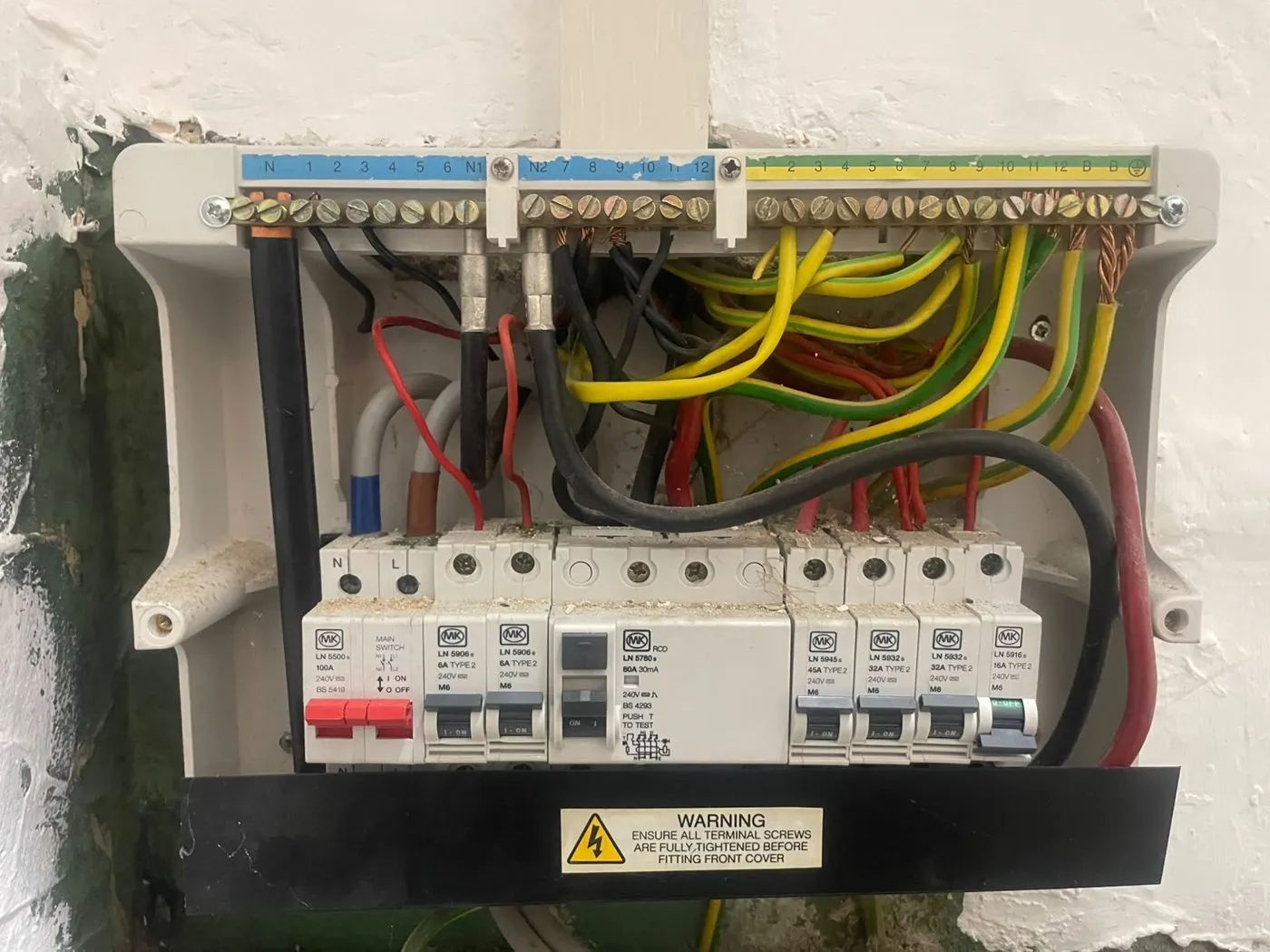
The old board was an MK split-load consumer unit: a 100A main switch, a single 80A 30mA RCD (made to the older BS 4293 standard) and a row of MCBs (6A, 6A, 16A, 32A, 32A and 45A).
Boards like this were normal for years, but they have two weak points:
- One RCD covers several circuits. If one appliance develops a fault, the RCD can switch off every circuit on that side at once, so you can lose sockets, shower and more together.
- Not every circuit is always RCD protected. On a split-load board, the circuits on the “non-RCD” side rely on the MCB alone. Today’s wiring rules expect 30mA RCD protection on almost all circuits in a home.
The plastic enclosure is also something that modern boards no longer use. Since 2016, consumer units in homes must have a non-combustible (normally metal) enclosure.
After: a new RCBO consumer unit with surge protection
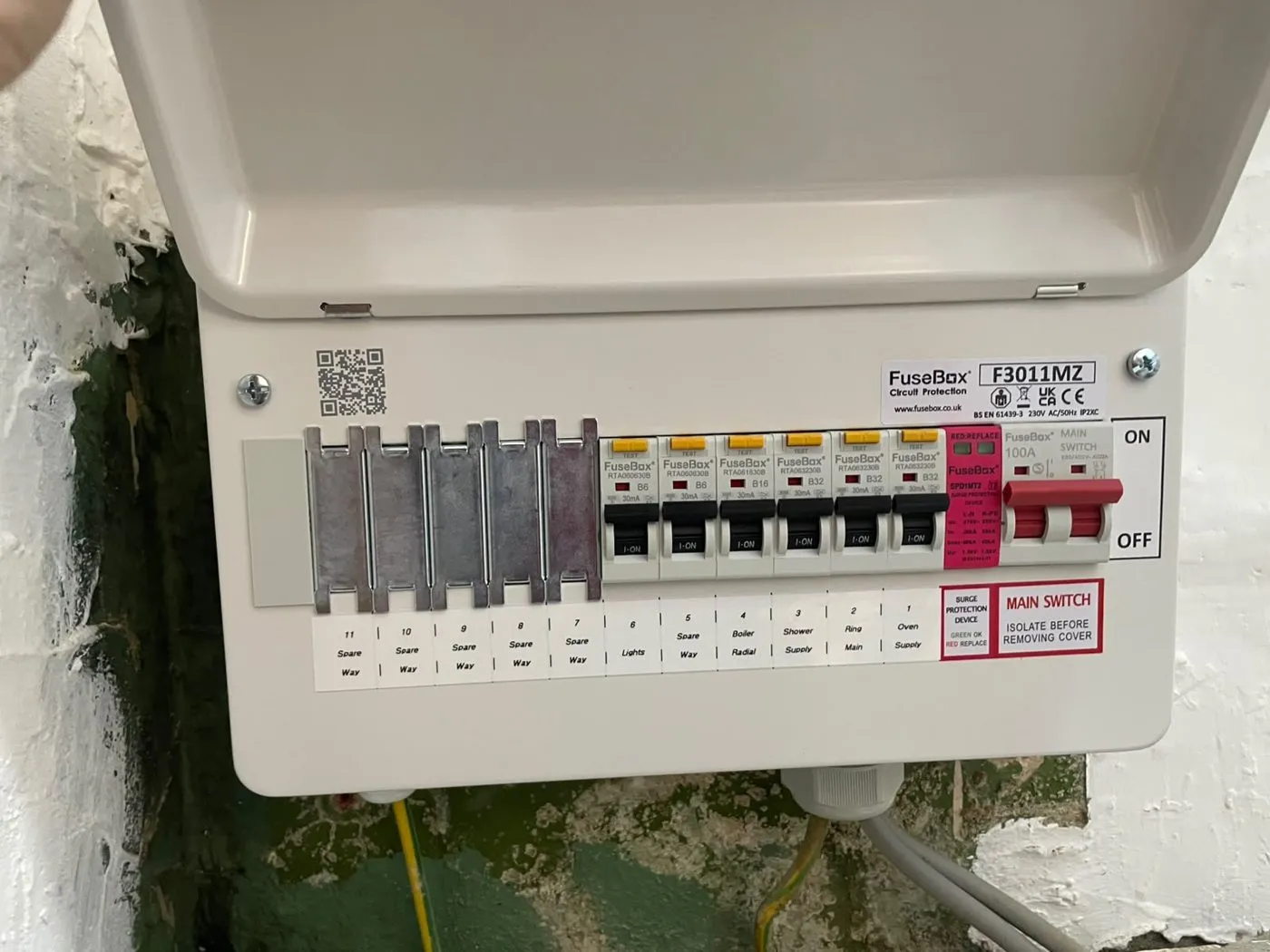
We replaced it with a new FuseBox F3011MZ metal consumer unit:
- A 100A main switch, clearly marked “isolate before removing cover”.
- A Type 2 surge protection device (SPD), which helps protect the wiring and your electronics from voltage spikes. It has a simple window: green is OK, red means replace.
- Six 30mA RCBOs, one per circuit. An RCBO combines an MCB and an RCD, so each circuit has its own earth-leakage protection. If the boiler circuit trips, the lights and sockets stay on.
- Every circuit labelled: oven, ring main, shower, boiler, lights.
- Spare ways left in the board, so new circuits (an EV charger or an outside socket, for example) can be added later without another board change.
Other things the EICR found
An EICR looks at the whole installation, not just the board. Our engineer also photographed two items for the report.
A socket fed with 0.75mm cable
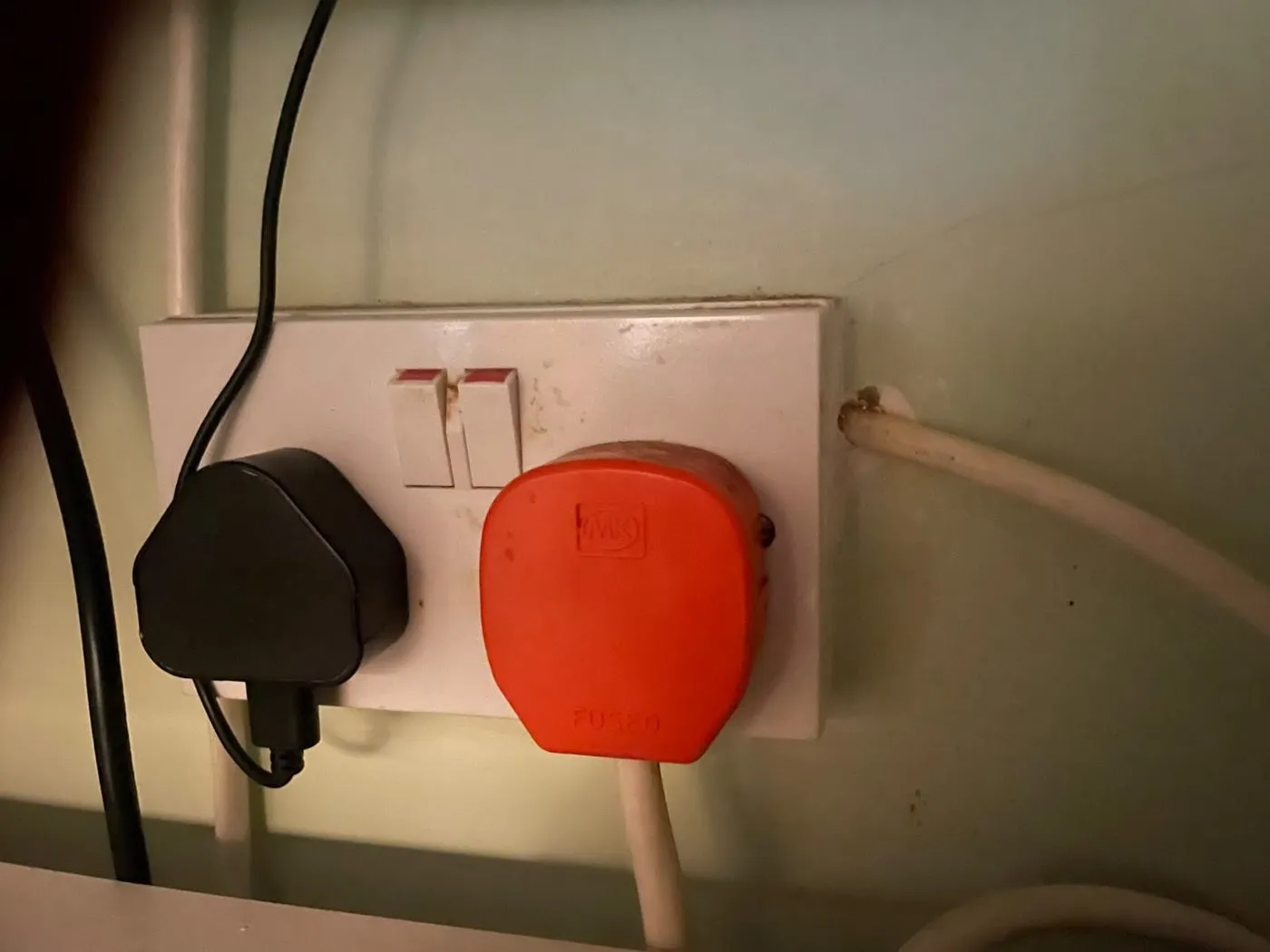
This double socket was fed by a thin 0.75mm² cable. Socket circuits are protected by a 32A device and are normally wired in 2.5mm² cable. A cable this small could overheat long before the breaker trips. This needs rewiring in the correct size cable. If you find more than one problem like this, a house rewire can be the better long-term fix.
A loose light switch
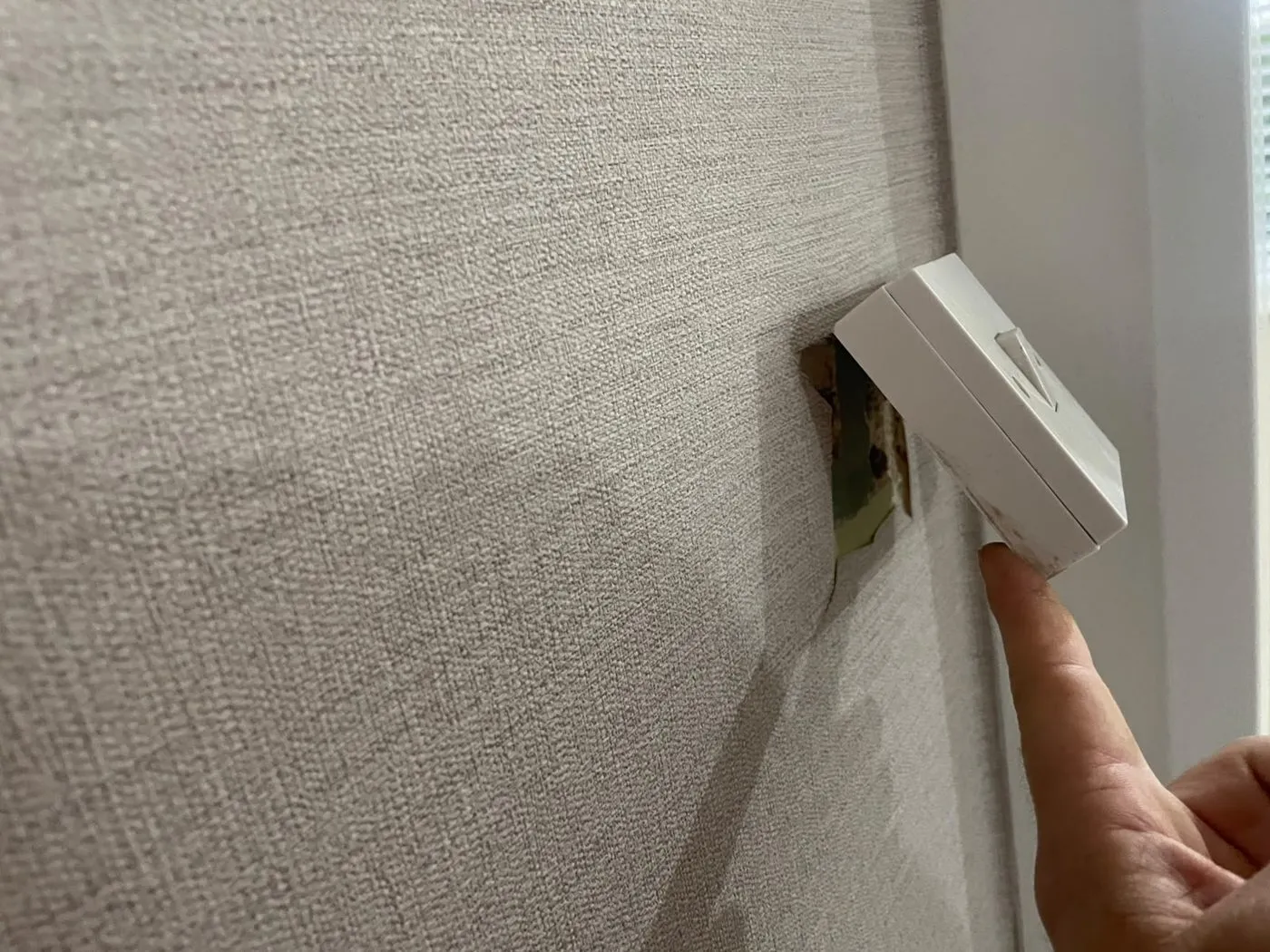
The switch plate was coming away from the wall, leaving a gap around the back box. A loose plate puts strain on the wires behind it and can expose live parts. It needs refixing to a secure back box.
Both were found and reported. They are not fixed yet.
Smoke, heat and CO alarms
Our EICR visits also record the alarms. Here the engineer noted no mains heat alarm in the kitchen and no carbon monoxide alarm near the boiler. Both are cheap to add and worth having. Landlords should read our smoke and CO alarm guide.
How to tell if your consumer unit needs replacing
Open the cover of your fuse box (don’t take anything apart) and look for these signs:
- One big RCD in the middle with a row of switches either side, instead of a separate RCBO for each circuit.
- A plastic case rather than metal.
- Old rewireable fuses, or no RCD at all.
- No labels, or labels you can’t read.
- Everything goes off at once when one thing trips.
If you see any of these, it doesn’t always mean danger, but it is worth getting an EICR. Our guide to consumer unit replacement explains the options, and RCD protection explained covers how RCDs and RCBOs work.
Need an EICR or a new consumer unit in Thurrock or Essex?
We carry out EICRs from £175 + VAT, and can quote for any remedial work or a new board on the same visit. See our consumer unit replacement service, EICR and compliance service and EICR codes explained. You may also like our consumer unit upgrade after an EICR in Soho and EICR remedial work in Collier Row.
Our engineers work across Essex every day, including Upminster, Hornchurch, Romford and Brentwood. Call 020 8227 0035 or request a quote.