

Wall-hung toilets with concealed cisterns look great: clean lines, nothing on show and easy cleaning underneath. But when something goes wrong, the cistern is hidden inside the wall or boxing, and many people don’t know how to get to it. Here’s how they work, what usually fails, and how a repair is done without damaging expensive tiles or stone.
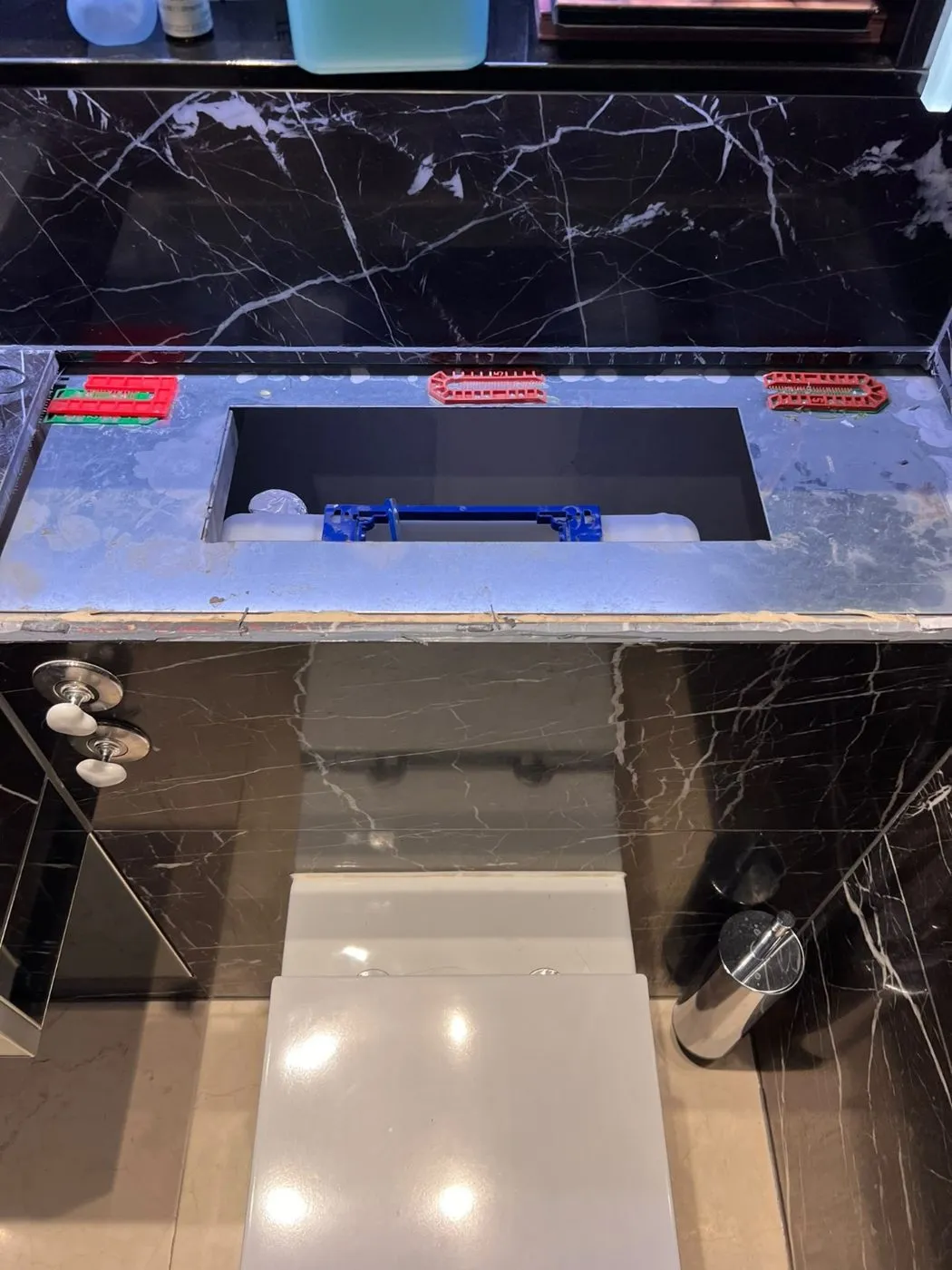
How a concealed cistern works
The cistern sits inside a steel frame behind the wall or boxing. There are two main ways in:
- through the flush plate: on most systems, removing the flush plate on the wall gives access to the fill valve, the flush valve and the isolation valve, so most repairs can be done through this opening
- through a removable top or panel: in some bathrooms, like the one above, the cistern is reached by lifting a removable top on the boxing, here a marble-clad top, giving access from above
Common faults
Toilet running constantly. Usually a worn flush valve seal, letting water trickle into the pan, or a fill valve that doesn’t shut off, so water runs to the overflow. Limescale is a frequent cause in hard-water areas.
Weak or no flush. Often a broken or misaligned actuator (the linkage between the flush plate buttons and the valve), a stuck flush valve, or a low water level.
Cistern not refilling. A blocked fill valve filter, a closed or faulty isolation valve, or a failed fill valve.
Leaks. Less common, but more serious, because a leak inside the boxing can go unnoticed until it damages floors or ceilings below. Signs include water around the base of the pan, staining on the boxing, or a ceiling mark in the room below.
How we repair them
- Isolate the water at the cistern’s isolation valve.
- Remove the flush plate or access top carefully, protecting tiles, stone and surrounding fittings.
- Diagnose the fault, checking the fill valve, flush valve, seals and actuator.
- Replace worn parts with genuine or compatible parts for the make of cistern. Concealed cisterns are brand-specific, so the right part matters.
- Descale and clean the valves where limescale is an issue.
- Test the flush and refill several times, and check for leaks before refitting the plate or top.
Most repairs are done in a single visit, without disturbing the tiling.
Planning a new bathroom? Plan the access
The most expensive concealed cistern repairs are the ones where nobody can get to the cistern. If the flush plate is in an awkward place, or the boxing has been tiled over with no removable panel, a simple repair can mean cutting out tiles or stone. When you’re designing a bathroom:
- make sure the flush plate is accessible and big enough to service through
- consider a removable top or panel on boxing, especially with stone or large-format tiles
- keep the cistern’s make and model noted somewhere, as it makes ordering parts much quicker
Get it fixed
Our plumbing team repairs concealed cisterns, wall-hung toilets and flush mechanisms for homeowners, landlords and letting agents. For close-coupled toilets, see our guide to running toilets and weak flushes. See our plumbing and heating service.
We cover London and Essex, with our own engineers working every day across Chigwell, Loughton, Buckhurst Hill, Woodford, Ilford, Romford, Brentwood and Epping. Call 020 8227 0035 or request a quote.