
Outdoor lights have a hard life. They face rain, frost, wind and sun all year round, and they’re often the first thing to cause trouble on an electrical installation. If an outside light keeps tripping your electrics, fills with water or has simply stopped working, here’s what’s usually going on and how to get it fixed properly.
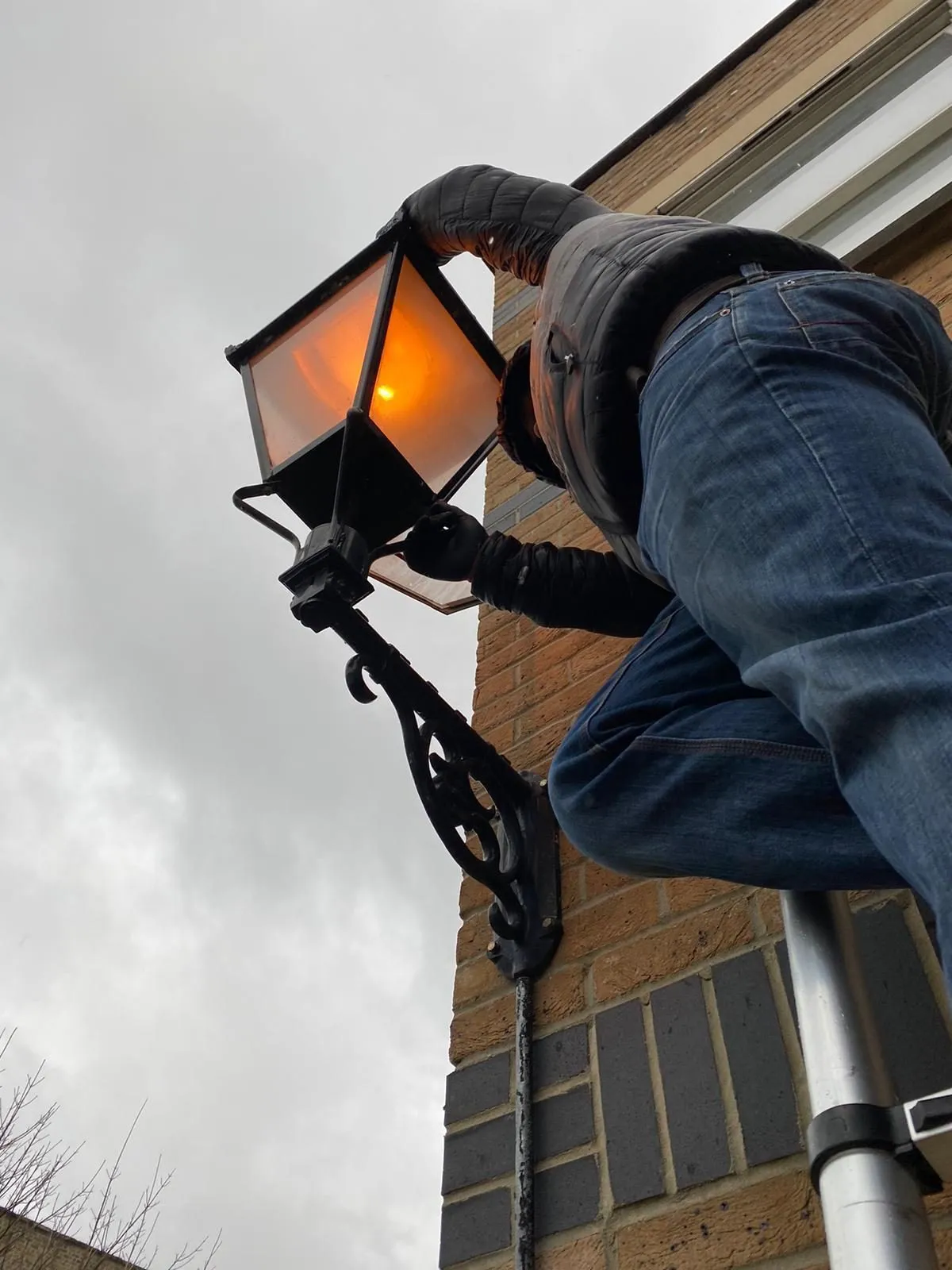
Why outdoor lights cause problems
Water getting in. Perished seals, a cracked lens or a fitting mounted the wrong way up let water in. Once moisture reaches the connections, the light can trip the RCD, often after heavy rain or overnight condensation. Our post on why your electric keeps tripping explains how to track this down.
The wrong fitting for the location. Indoor-rated or cheap fittings used outside won’t last long. Check the IP rating (see below).
Corroded connections. Older fittings, especially metal lanterns like the one above, can corrode inside over the years. Connections loosen, lamp holders fail, and the light flickers or dies.
Failing sensors. PIR motion sensors and photocells (dusk-to-dawn sensors) wear out, get dirty or get knocked out of alignment. The light then stays on all day, never comes on, or triggers constantly.
Understanding IP ratings
The IP (ingress protection) rating tells you how well a fitting keeps out dust and water. The first digit covers solid objects, the second covers water.
- IP44 protects against splashing water. It’s suitable for sheltered spots, like under a porch canopy.
- IP65 is dust-tight and protected against water jets. It’s a good choice for exposed walls and gardens.
- IP67 and IP68 cover temporary or continuous immersion. They’re for ground-level and in-ground lights that might sit in puddles.
As a rule, the more exposed the position, the higher the rating you need. The cable entry and connection box need to be weatherproof too, not just the light itself.
Safety requirements
- RCD protection. Outdoor lighting circuits and outside sockets should be protected by an RCD, so a fault can’t leave anything touchable live. If yours aren’t, we’d recommend upgrading your consumer unit.
- Suitable cable. Cable run outdoors or buried in the garden needs to be the right type, properly protected and installed at the right depth.
- Working at height. Many external lights sit above a door or high on a wall. We use the right access equipment for the job rather than leaning out of an upstairs window.
Upgrading at the same time
If you’re replacing a failed fitting anyway, it’s a good time to:
- switch to LED, which uses far less power and lasts far longer
- add a photocell or PIR sensor, so lights only run when needed
- add a smart switch or timer for security lighting
- light paths and steps for safety, not just the front door
For landlords, agents and managing agents
External and communal lighting is a regular item on our planned maintenance visits for blocks and rental properties. Lights out on paths, car parks and entrances are a safety and security risk, so they’re worth fixing promptly. We can combine lamp changes, sensor repairs and emergency lighting checks in one visit.
Get it fixed
Send us a photo of the light and where it’s mounted, and we can usually price it without a visit. Call 020 8227 0035 or request a quote. Positive Contractors is an NICEIC Approved Contractor based in Chigwell, covering London and Essex.
We cover London and Essex, with our own engineers working every day across Chigwell, Loughton, Buckhurst Hill, Woodford, Ilford, Romford, Brentwood and Epping.