
A heated towel rail is one of the most requested bathroom upgrades we fit. It keeps towels dry, helps fight condensation and mould, and makes a small bathroom feel warm without a bulky radiator. Before you buy one, though, it helps to know which type suits your home and what fitting it involves.
Three types of towel rail
Central heating (wet) towel rails connect to your heating pipework like a radiator. They’re cheap to run, but they only get warm when the heating is on, so in summer your towels stay damp.
Electric towel rails are filled with fluid at the factory and heated by an element. They’re wired into your electrics and work all year round, independently of the boiler. They’re also the only option where there are no heating pipes nearby.
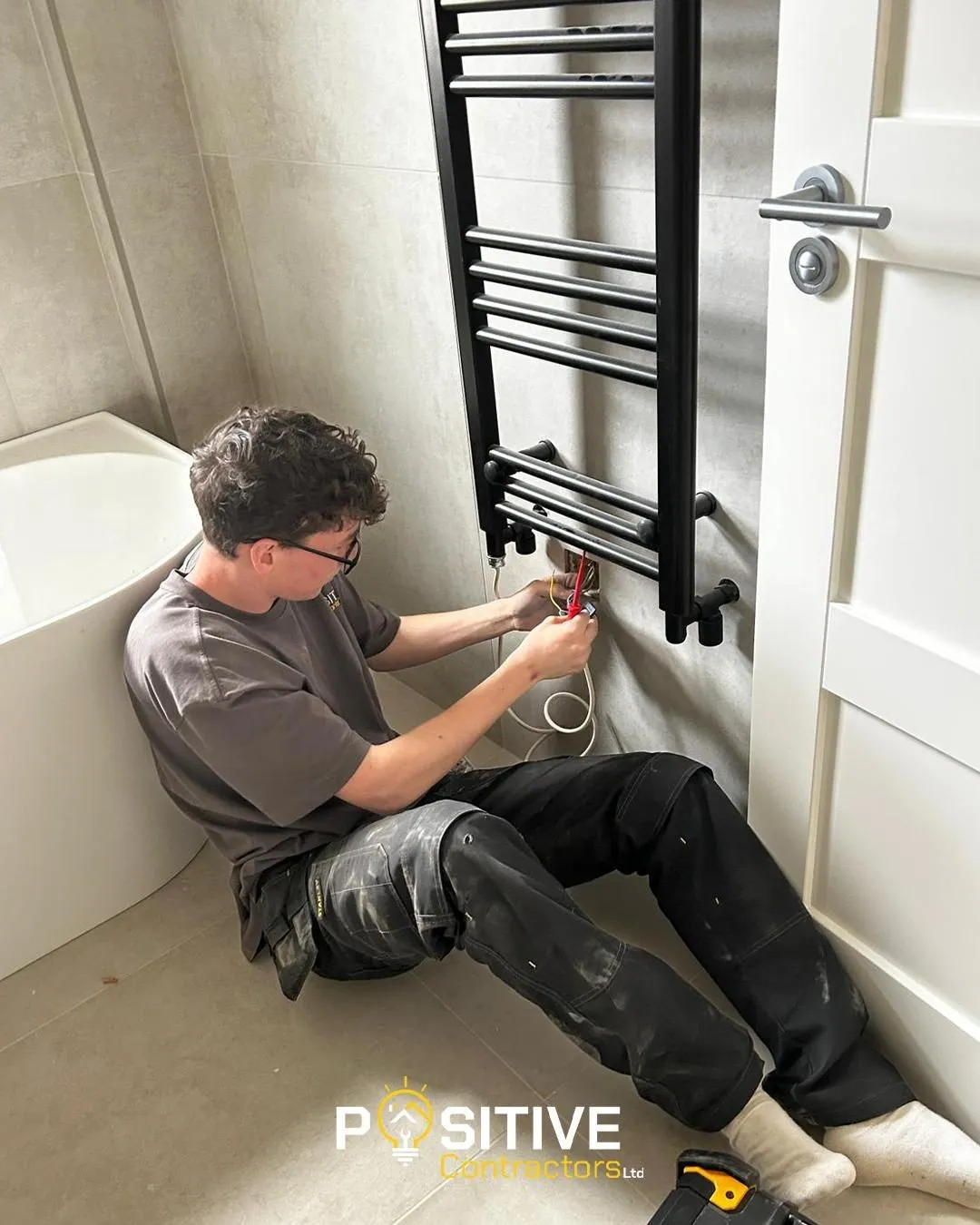
Dual-fuel towel rails give you both. The rail is plumbed into the heating, so it warms up with the radiators in winter, and an electric element (fitted with a T-piece valve) lets you heat it on its own in summer. The rail in the photo above is a dual-fuel rail. Our electrician is connecting the element while the plumbing work is completed alongside.
Electrical safety in bathrooms
Bathrooms are treated as a special location in the wiring regulations, because water and electricity are a dangerous mix. For a towel rail, that means:
- RCD protection. Every circuit serving a bathroom must be protected by an RCD.
- The right connection point. Towel rails are usually hard-wired through a fused connection unit with a flex outlet, not plugged into a socket. The switch has to be in a position, or have a rating, that’s safe for its distance from the bath or shower.
- Supplementary bonding may be needed if the installation doesn’t meet current requirements.
- Certification. You should receive a certificate for the electrical work. Installing a new circuit in a bathroom is notifiable under Part P, which a registered electrician handles for you.
If your home is older, or your board has no RCDs, we may recommend upgrading it first. See our consumer unit replacement guide.
Timers, thermostats and running costs
An element left on all day costs money for no benefit. Look for a towel rail or element with:
- a thermostat, so it holds a comfortable temperature rather than running flat out
- a timer or programmer, so it comes on before your morning shower and switches off after
- smart control, if you’d like to manage it from your phone alongside your heating
We can also fit a timed fused spur outside the bathroom where the rail’s element doesn’t have its own controls.
One plumbing point on dual-fuel rails
A dual-fuel element must always sit in a rail that’s full of water. Running the element in a partly drained rail can damage it. If the heating system is ever drained down, the rail needs refilling and bleeding before the element is used again. A good installer will show you how the valves work at handover.
Why use one contractor for both trades
A dual-fuel rail needs a plumber and an electrician, and often a tiler too. Booking separate trades means more visits and more chance of one waiting on another. Our own team covers plumbing and heating and electrical work, so the rail is plumbed, wired, tested and certified in one visit wherever possible.
Get a quote
Send us a photo of your bathroom and the rail you have in mind, and we can usually price the job without a visit. Call 020 8227 0035 or request a quote. Positive Contractors is an NICEIC Approved Contractor and Gas Safe registered, based in Chigwell and covering London and Essex.
We cover London and Essex, with our own engineers working every day across Chigwell, Loughton, Buckhurst Hill, Woodford, Ilford, Romford, Brentwood and Epping.