
Legionella bacteria live naturally in water. In the right conditions, they multiply in a building’s water system and can cause Legionnaires’ disease, a serious form of pneumonia, when people breathe in fine droplets from showers, taps and spray. Keeping water at the right temperature is one of the main ways to keep Legionella under control, and regular temperature checks show whether a system is doing its job.
Who is responsible?
Under health and safety law, anyone who controls premises with a water system, including employers, businesses, managing agents and landlords, must identify and control the risk from Legionella. The Health and Safety Executive’s guidance (the Approved Code of Practice L8 and technical guidance HSG274) sets out how.
- Businesses and larger buildings need a written Legionella risk assessment, a written scheme of control, and a programme of checks, often including monthly temperature monitoring.
- Residential landlords must also assess the risk in their rental properties. For most simple domestic systems, the risk is low and can be controlled with straightforward measures, but it still needs to be assessed and recorded.
The temperatures that matter
Legionella multiplies most between roughly 20°C and 45°C. Control is about keeping water out of that range:
- Cold water should be below 20°C, reached within about two minutes of running the tap
- Hot water should be stored at 60°C or above in cylinders and calorifiers
- Hot water at outlets should reach at least 50°C within about one minute (55°C in healthcare settings)
How temperature checks are done
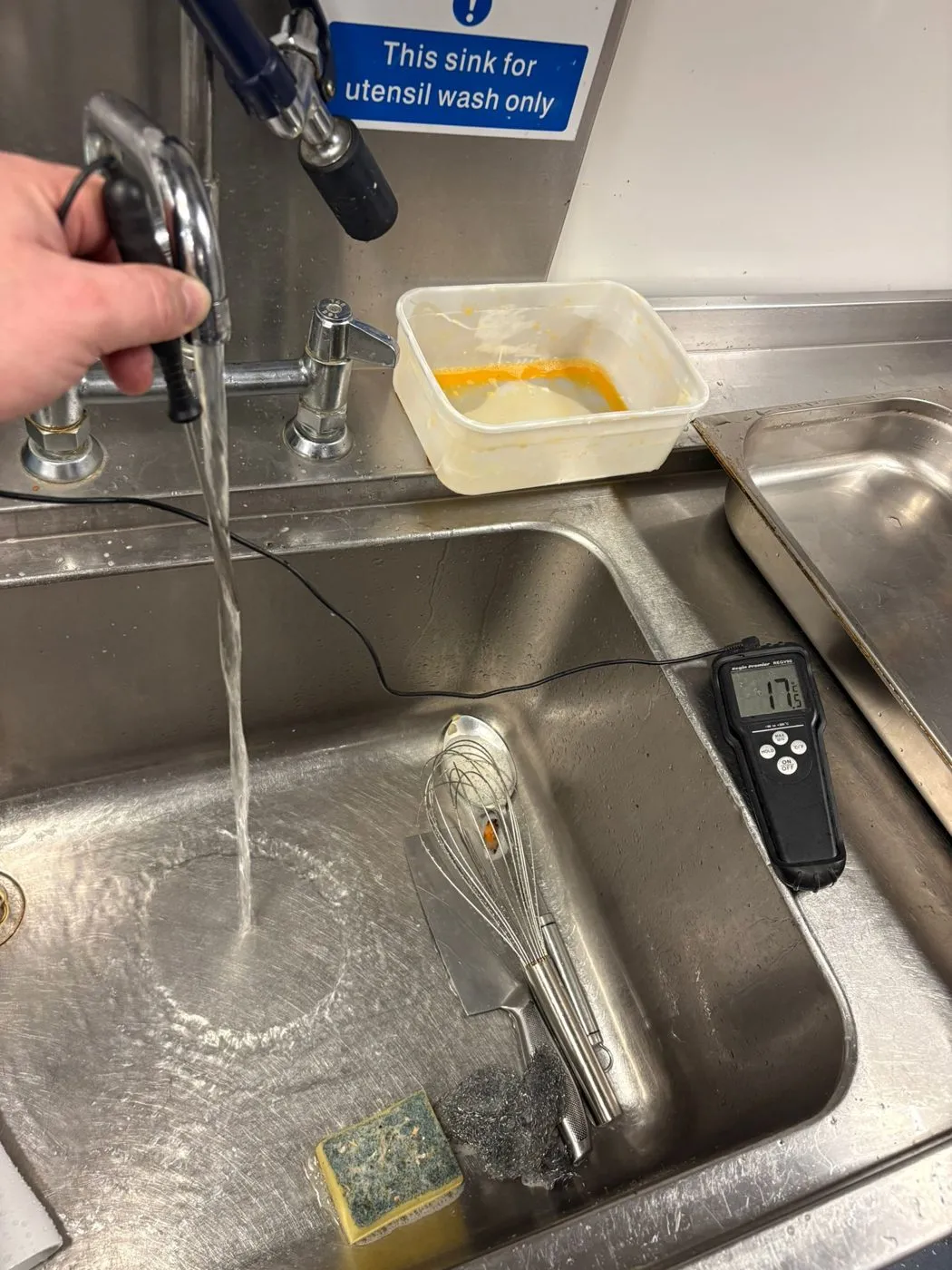
We use a calibrated probe thermometer held in the flow at each outlet. On the cold tap in this commercial kitchen, the reading came in comfortably below 20°C, within the expected range.
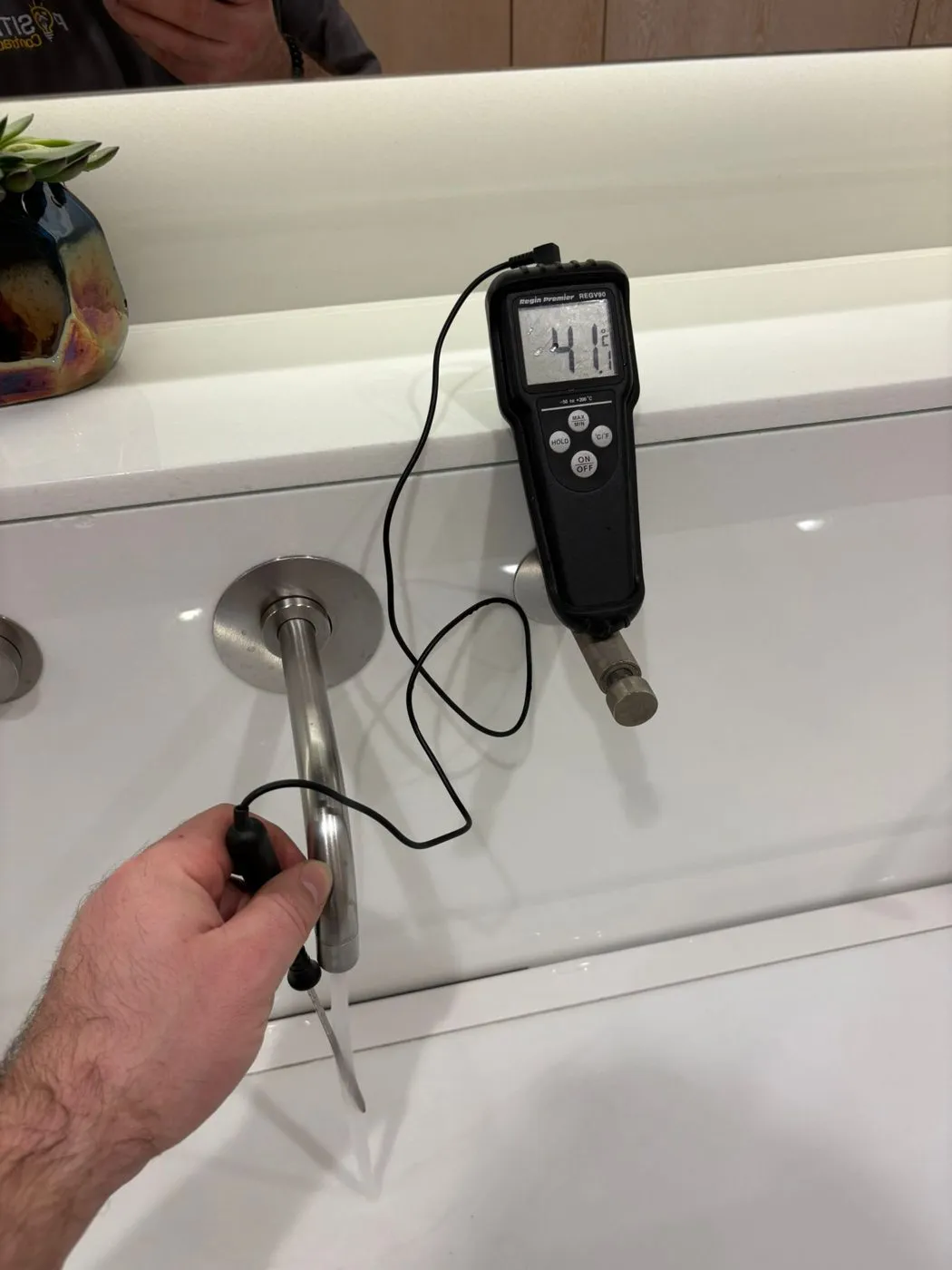
At outlets fitted with thermostatic mixing valves (TMVs), such as many baths and basins, especially in care, healthcare and family settings, the water is deliberately blended down to a safe temperature, often around 41°C, as here, to prevent scalding. At these outlets, what matters is that the hot supply before the mixing valve is hot enough, the mixed pipework run is kept short, and the valve itself is maintained and checked. Readings are recorded so trends can be spotted over time.
A typical monitoring visit includes:
- sentinel outlets: the nearest and furthest taps from the hot water source, checked regularly
- hot water storage temperatures at cylinders or calorifiers
- cold water storage tanks, where fitted, checked for temperature, cleanliness and secure lids
- shower heads and hoses, descaled and disinfected periodically
- little-used outlets, flushed weekly so water doesn’t stagnate
What if readings are out of range?
- Cold water too warm: pipes may be running near heat sources, tanks may be oversized or warming up, or water may be stagnating. Insulation, rerouting and flushing help.
- Hot water not hot enough: the cylinder thermostat, boiler settings, circulation pump or pipe insulation may need attention.
- Dead legs (pipework that no longer serves an outlet) should be removed, because water sits in them at lukewarm temperatures.
Simple steps for landlords
- keep the hot water cylinder set to 60°C
- flush outlets in empty properties before a new tenant moves in, and run little-used taps and showers regularly
- keep cold water tanks covered and clean
- tell tenants to report hot water that isn’t hot, and to clean and descale shower heads
- record your risk assessment and what you’ve done
Book temperature monitoring
We carry out water temperature checks, flushing, shower head descaling and remedial plumbing work for landlords, managing agents and businesses, with readings recorded for your compliance file. See our plumbing and heating service and landlord safety certificates checklist.
We cover London and Essex, with our own engineers working every day across Chigwell, Loughton, Buckhurst Hill, Woodford, Ilford, Romford, Brentwood and Epping. Call 020 8227 0035 or request a quote.