
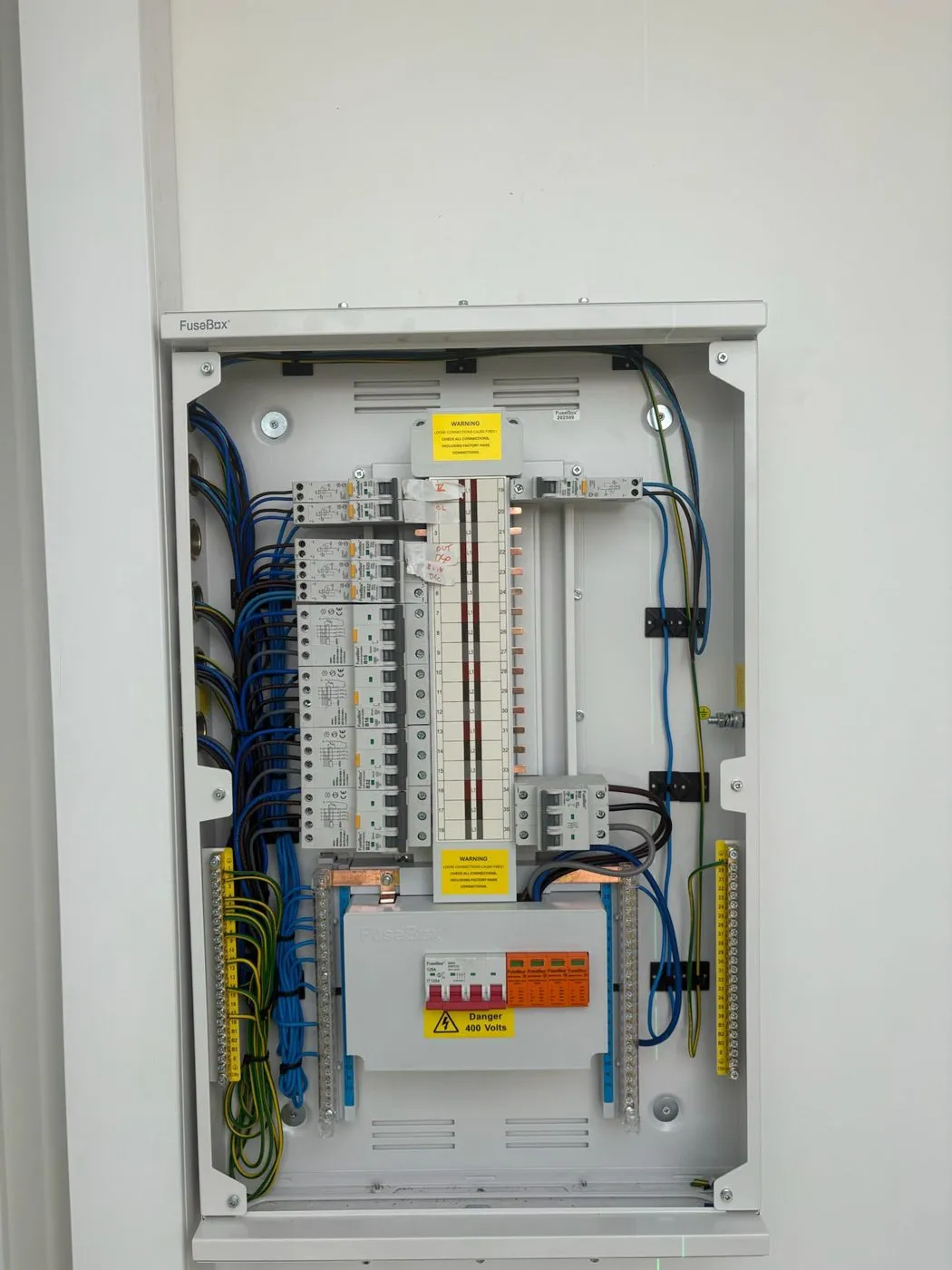
Industrial and commercial premises often run equipment that a standard single-phase supply can’t handle. On this industrial site we installed a new three-phase distribution board to power the unit’s lighting, sockets and heavier equipment safely, with modern protection on every circuit.
What is three-phase power?
Most homes have a single-phase supply: one live conductor and a neutral, at 230 volts. A three-phase supply has three live conductors (L1, L2 and L3) plus a neutral. Each phase still gives 230V to neutral, but there are 400 volts between phases. That’s why you’ll see the “Danger 400 Volts” label on the board.
Three-phase lets a building:
- run heavy equipment such as machinery, compressors, lifts and large motors
- share the load across three phases, so no single phase is overloaded
- support high-power additions like 22kW EV chargers, commercial heat pumps and catering equipment
What we installed
The new board includes:
- A 125A four-pole main switch to isolate all three phases and the neutral together
- A three-phase surge protection device (SPD), the orange modules beside the main switch, which protects the installation and sensitive equipment from voltage spikes
- RCBOs on single-phase circuits for lighting and sockets, so a fault on one circuit only switches off that circuit
- Four-pole RCD-protected devices for three-phase circuits, giving earth fault protection on the heavier loads
- A three-pole breaker for a dedicated three-phase feed
- An armoured (SWA) supply cable entering through a proper gland at the bottom of the board
Installation and load balancing
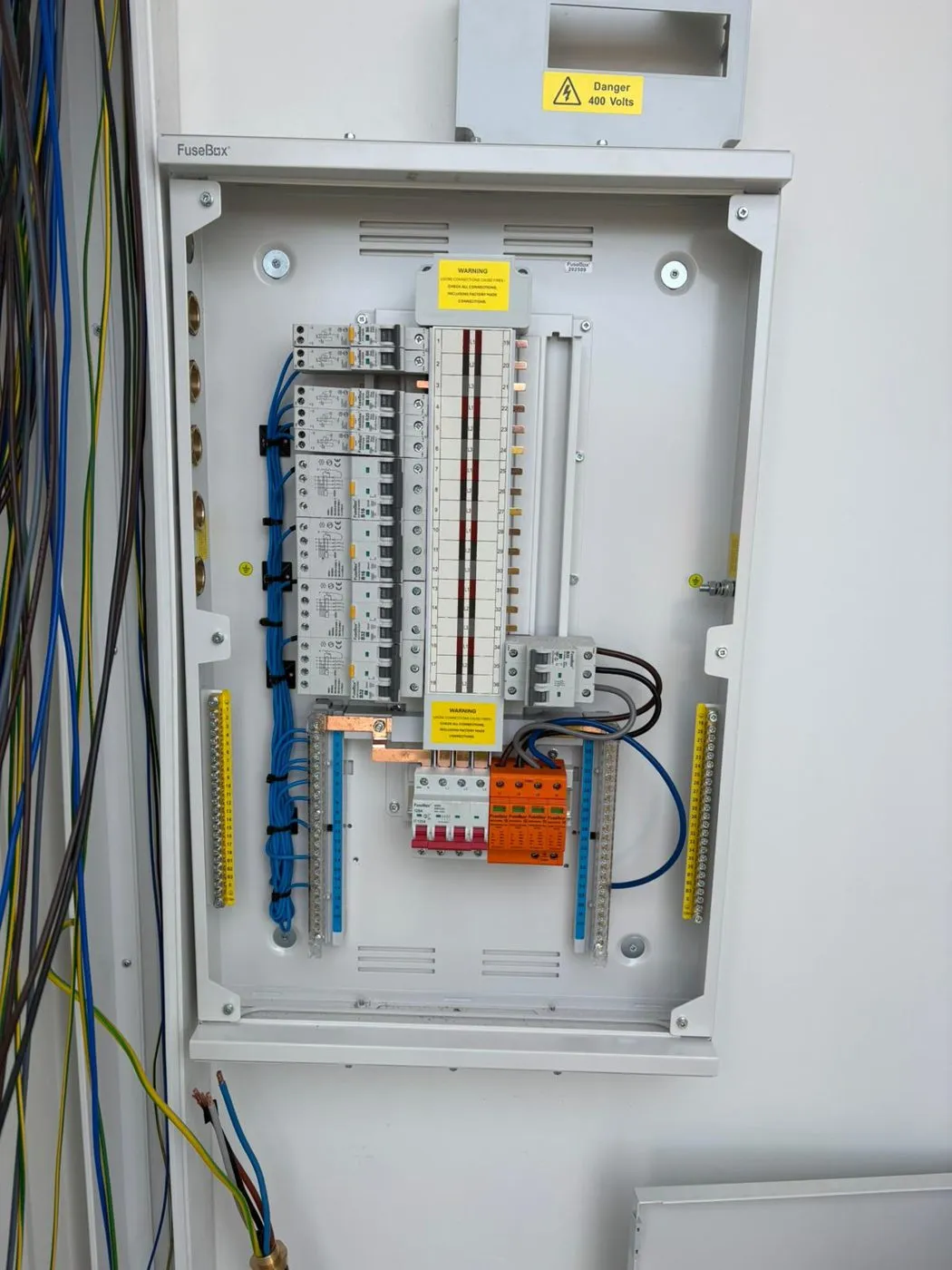
A three-phase board is only as good as the planning behind it. Before connecting anything, we work out the expected load on each circuit and spread the single-phase circuits across L1, L2 and L3. Balanced phases mean:
- less risk of overloading one phase while the others sit idle
- lower neutral current
- more spare capacity for future equipment
Every circuit cable was dressed neatly into the board, terminated, labelled and recorded on the circuit chart. This makes future fault-finding and alterations far quicker.
Testing and certification
Once connected, every circuit was tested: continuity, insulation resistance, polarity, earth fault loop impedance, prospective fault current, RCD and RCBO operation, and phase rotation on the three-phase circuits. The client received an Electrical Installation Certificate covering the new installation.
Keeping it compliant
Commercial and industrial installations need regular inspection. Industry guidance recommends an EICR at least every five years for commercial premises and every three years for industrial premises, or sooner where the environment or your insurer requires it. Our EICR and compliance service can schedule these for you.
Need three-phase work?
Whether you’re upgrading a unit for new machinery, adding EV charging, or fitting out a new commercial space, our NICEIC-approved electricians can design, install and certify the work. See our electrical services and commercial fit-outs, or call 020 8227 0035 to discuss your project.
We cover London and Essex, with our own engineers working every day across Chigwell, Loughton, Buckhurst Hill, Woodford, Ilford, Romford, Brentwood and Epping.