People often ask us what an air con pressure test actually is, and why an engineer can’t just “top up the gas”. This job in a flat in Mayfair, London (W1K) shows the whole process, step by step, with the real readings from the day.
The job
The flat has a ducted air conditioning system, with the indoor unit hidden in the ceiling and the outdoor unit outside. We were booked for a routine F-gas leak check (also called a containment check). When we got there, the system had already shut itself down: it had sensed a refrigerant leak and gone into an emergency pump-down, which pulls the gas back into the outdoor unit to protect the compressor.
So the leak check became a leak repair.
Step 1: recover the refrigerant
You can’t open a system that still has gas in it, and refrigerant must never be let out into the air. We connected a recovery machine and cylinder to the outdoor unit, set the system to open all its valves, and recovered 3.5kg of refrigerant.
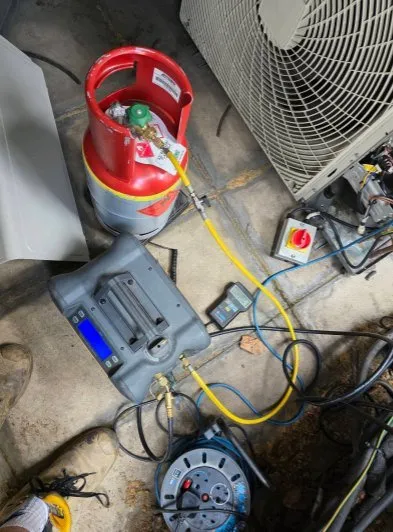
Step 2: find the leak with tracer gas
Next we filled the empty system with tracer gas at 32 bar. Tracer gas is safe and easy to detect, so with the system under high pressure we could go along the pipework and joints with a detector until we found where it was escaping.
The leak was at the flare joint on the liquid line, right at the ducted indoor unit serving the living room, high up in the ceiling.
Step 3: fix the cause, not just the symptom
When we took the joint apart, we could see why it leaked. A flare joint is where the end of a copper pipe is opened out into a cone so it seals against a brass fitting. Before flaring, the cut end of the pipe has to be deburred (the sharp lip from the pipe cutter is cleaned off). This one never had been, so it could never seal properly. Topping up the gas would only have bought a few weeks before it leaked out again.
We cut off the bad end, made a new flare and tightened it to the manufacturer’s torque setting.
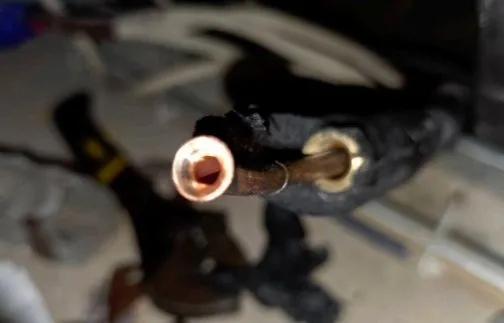
Step 4: the pressure test
This is the part most people mean by an air con pressure test. We pressurised the system to 34 bar and left it for an hour and a half. A system with even a small leak loses pressure over that time. Ours showed no pressure drop at all, so we knew the repair had worked.
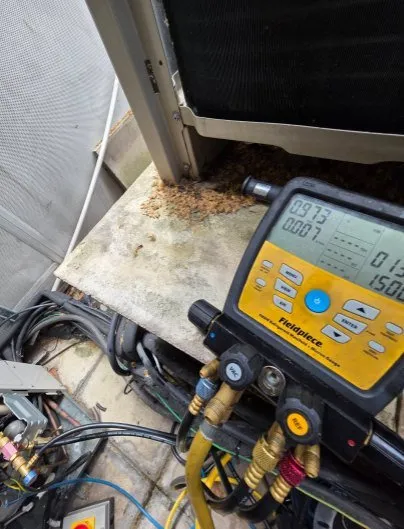
Step 5: vacuum and dry the system
Air and moisture inside an AC system damage the compressor and stop it cooling well. We pulled a deep vacuum below 2 torr to boil off any moisture, then did a rise test: we closed it off and watched the gauge. It held steady at 800 microns, which shows the system is dry and still leak-free.
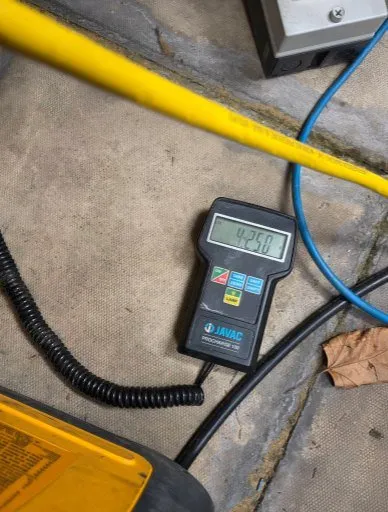
Step 6: recharge and test
We measured the pipe run, worked out the correct charge, and put in 4.5kg of new R32 refrigerant. That is more than the factory amount, because this system has long pipe runs. The unit’s label didn’t show any extra charge, which is also why we recovered more than the label said was in it.
Then we ran it in cooling and heating. In cooling, air went into the unit at 29.5°C and came out at 9.7°C. That is a strong result, and the system was left fully working.
Air con pressure test: quick answers
What is an air conditioning pressure test? The system is filled with dry nitrogen or tracer gas at high pressure (usually around 30 to 40 bar) and left for a set time. If the pressure holds, there are no leaks. It is done after a repair or a new install, before any refrigerant goes back in.
Why not just top up the gas? Refrigerant doesn’t get “used up”. If it’s low, it has leaked out somewhere. A top-up without finding the leak means paying again when it leaks out again, and it’s bad for the environment.
What are the signs of a refrigerant leak? The AC blows less cold air than it used to, runs for ages without cooling the room, ices up, shows an error code, or shuts itself down like this one did.
Does my system need F-gas leak checks? Systems holding refrigerant equal to 5 tonnes of CO2 or more need regular leak checks by an F-gas certified engineer. Many larger flat and office systems fall into this. Your engineer can tell you from the unit’s label.
How long does it take? The pressure test alone was an hour and a half here. The whole job (recovery, leak finding, repair, test, vacuum and recharge) takes most of a day.
Need an air conditioning engineer in London?
We repair and service air conditioning, fan coil units and comfort cooling for landlords, managing agents, homeowners and businesses across London. See our air conditioning and HVAC servicing page, or recent AC jobs near you in Mayfair, Westminster and Soho, Covent Garden, Canary Wharf, the City of London and Islington.
Call 020 8227 0035 or request a quote.