

Underfloor heating is comfortable and efficient when it works. When it doesn’t, it can be confusing, because the pipes are buried in the floor and the controls are spread around the house. A cold room is rarely a problem with the pipes themselves. Usually it’s the controls: thermostats, wiring, actuators or the pump. That’s why an investigation needs both an electrician and a plumber.
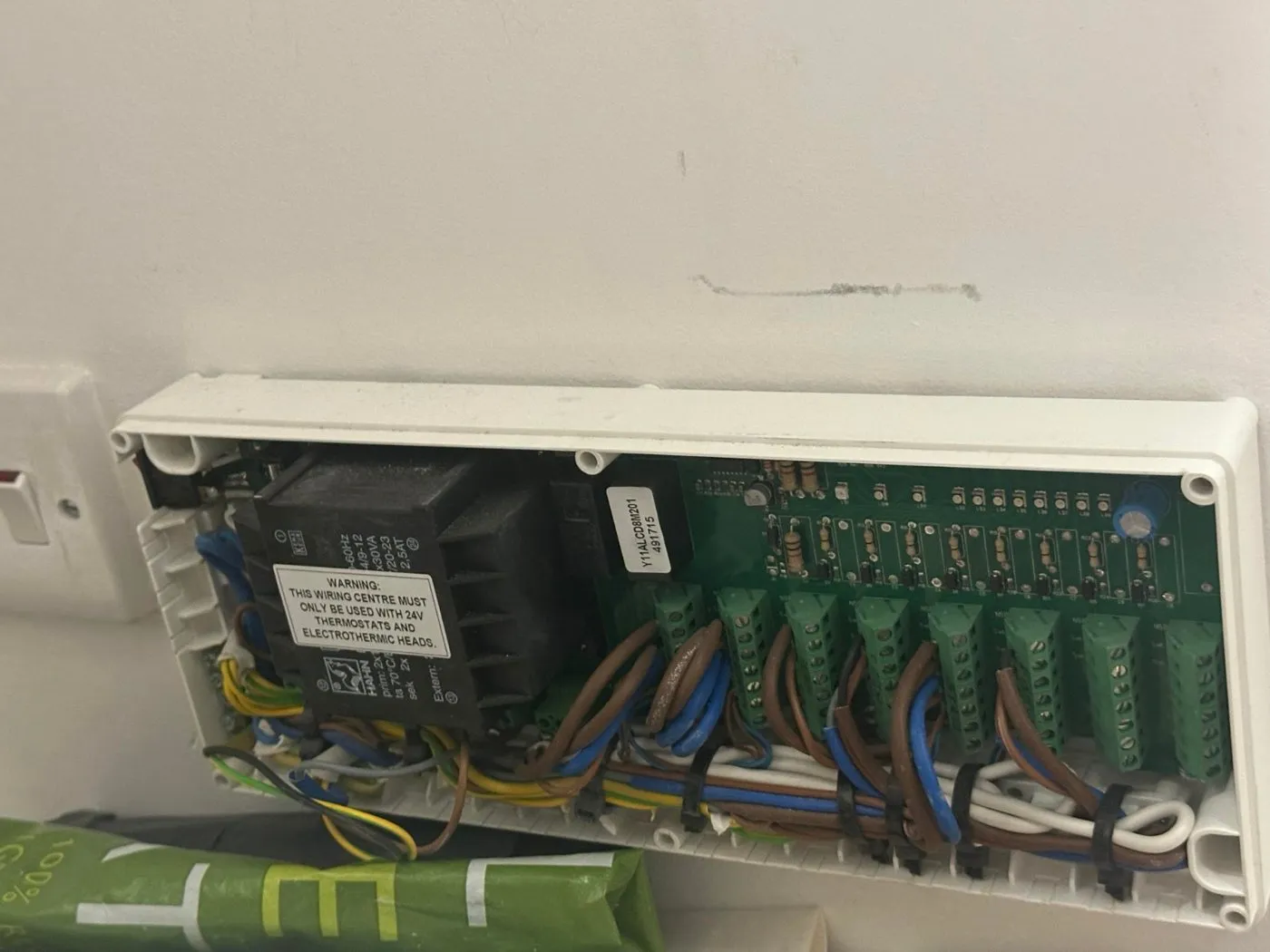
How wet underfloor heating is controlled
A typical system has:
- room thermostats in each zone, which call for heat
- a wiring centre, the control box in the photo above, which receives those calls and switches the right zones on. Many run on a 24V supply from a built-in transformer, as the warning label here says.
- actuators (electrothermic heads) on the manifold, which open each zone’s loop of pipe when it calls for heat
- a pump and mixing valve at the manifold, which circulate water at the right temperature
- a boiler or heat source, switched on by the wiring centre whenever any zone needs heat
If any link in that chain fails, a room, or the whole system, stays cold.
Common faults we find
One room cold, others fine
- thermostat fault, flat batteries, or lost wireless pairing
- failed actuator on that zone’s manifold port, a very common fault
- a loose or broken connection at the wiring centre for that zone
- air in that loop, or the loop’s flow valve set too low or closed
Whole system cold
- no power to the wiring centre: a tripped spur or fuse, or a failed transformer
- the pump not running
- the boiler not being asked for heat, often a wiring centre or boiler link fault
- low system pressure or a boiler fault
Floors warm but rooms don’t heat up properly
- flow temperature set too low at the mixing valve
- loops out of balance
- heavy rugs or furniture insulating the floor
How we investigate
- Check the thermostats: settings, batteries, pairing and the call for heat.
- Open the wiring centre, isolated safely, and check its power supply, transformer, zone indicator lights and connections.
- Test the actuators, confirming each one opens when its zone calls for heat. Failed heads are easy to replace.
- Check the manifold: pump, mixing valve, flow meters, pressure and air in the loops.
- Check the heat source is receiving a demand signal and supplying hot water.
- Use a thermal camera to see where the heat is and isn’t going (see below).
- Report and repair: replace faulty parts, rebalance the loops and test every zone.
Fault finding with a thermal camera
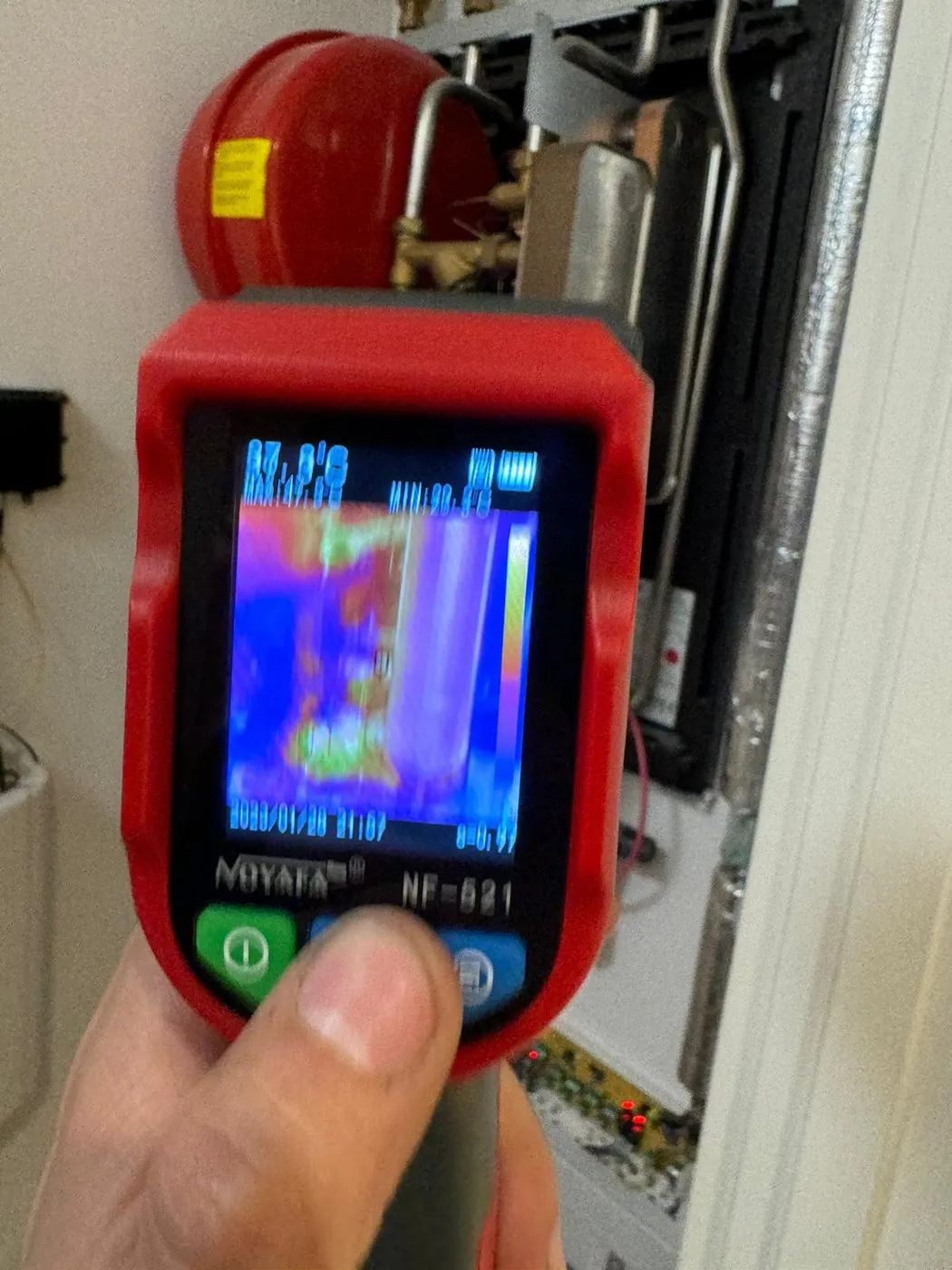
A thermal imaging camera shows temperature as colour, which makes heating faults far quicker to find without lifting floors:
- at the heat source and manifold: confirming hot water is actually leaving the boiler or heat source, and seeing which manifold ports are warm and which stay cold
- on the floor: once a zone is running, the pipe loops show up as warm lines on the camera, so a cold patch or a loop that never warms points straight to the problem
- on pipework and valves: spotting blockages, stuck valves or a mixing valve that isn’t letting enough heat through
It doesn’t replace electrical testing and pressure checks, but it narrows the search quickly and avoids unnecessary disruption.
What we found on this job
On this job, the underfloor heating was supplied from a heat interface unit (HIU). The fault was in the HIU: the primary strainer was blocked, and the plate heat exchanger and circulation pump had failed, so not enough heat was reaching the underfloor system. Charlie cleared the strainer and replaced the plate heat exchanger and circulation pump, which restored the heat to the floors. See our guide to HIU repairs.
Look after your underfloor heating
- keep thermostats on sensible schedules; underfloor heating works best with steady temperatures, not short bursts
- don’t block floor areas with thick rugs over heated zones
- have the system and boiler serviced annually
- note which thermostat controls which zone, as it speeds up fault-finding later
Book an investigation
Because underfloor heating faults can be electrical, plumbing or both, our electricians and plumbers work together to find the cause quickly. See our plumbing and heating service, electrical services, and our guide to radiator problems.
We cover London and Essex, with our own engineers working every day across Chigwell, Loughton, Buckhurst Hill, Woodford, Ilford, Romford, Brentwood and Epping. Call 020 8227 0035 or request a quote.